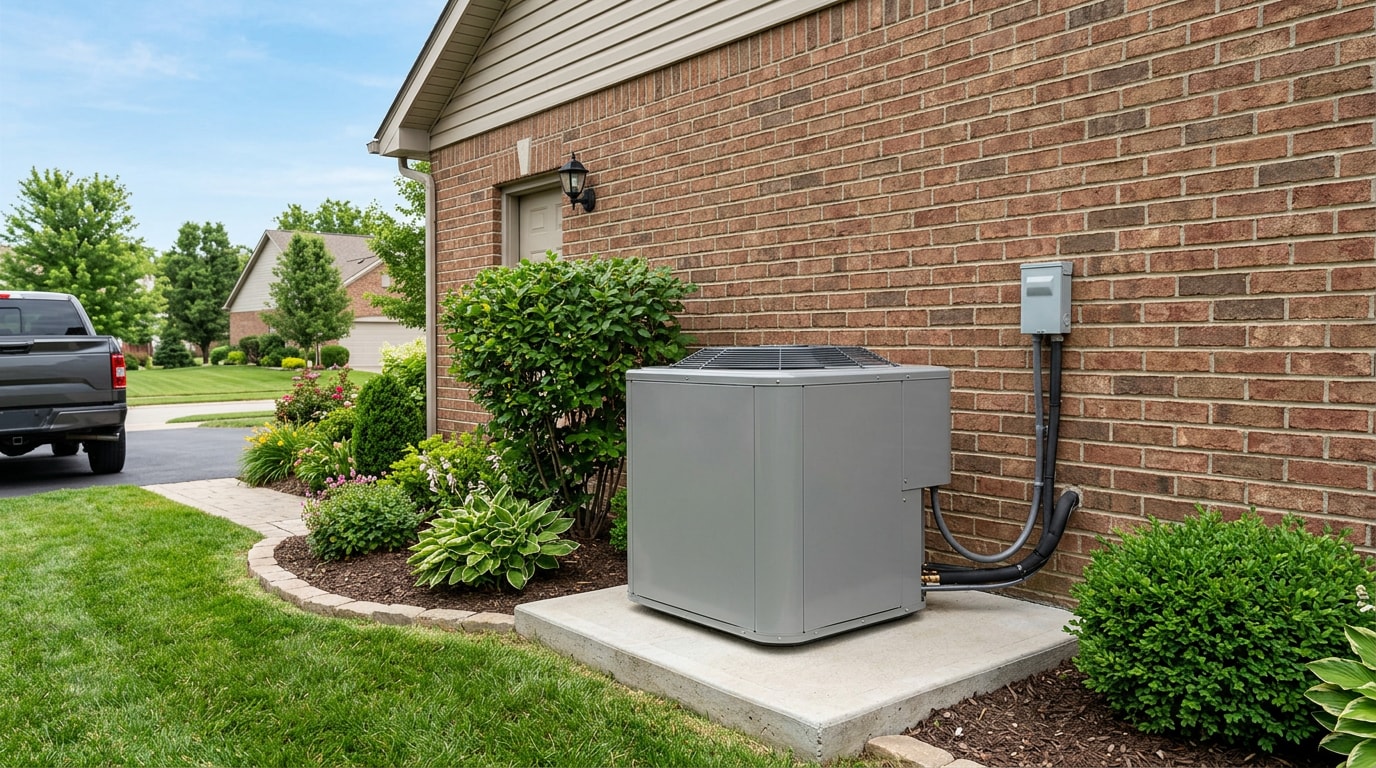
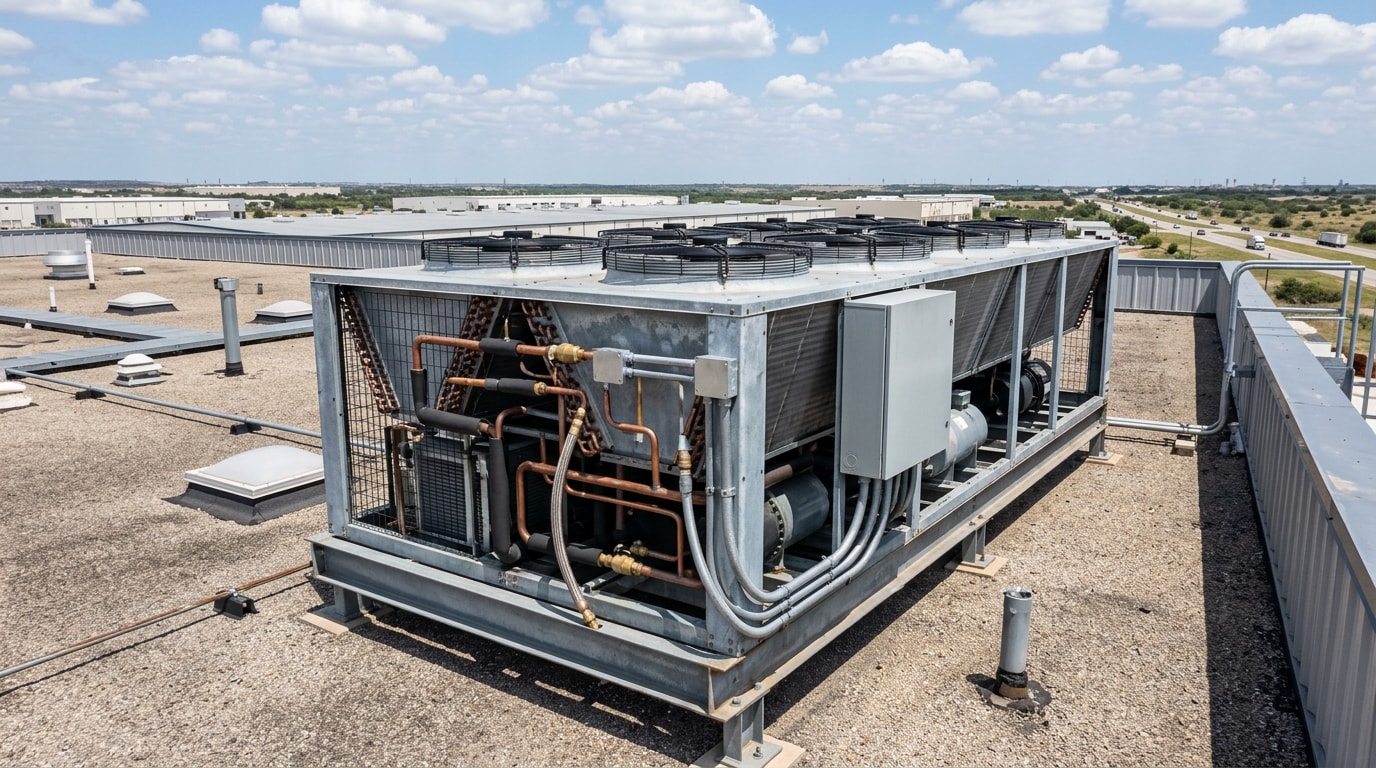
Chiller HVAC in Navasota, TX comes up whenever a building gets too large or too load-intensive for a standard rooftop unit to handle well. A chiller isn't the same piece of equipment as a residential air conditioner, and knowing the difference matters before you commit budget to a new system. This guide walks through how chillers work, which type fits different Grimes County buildings, and what installation typically costs in 2026.
What Is a Commercial HVAC Chiller?
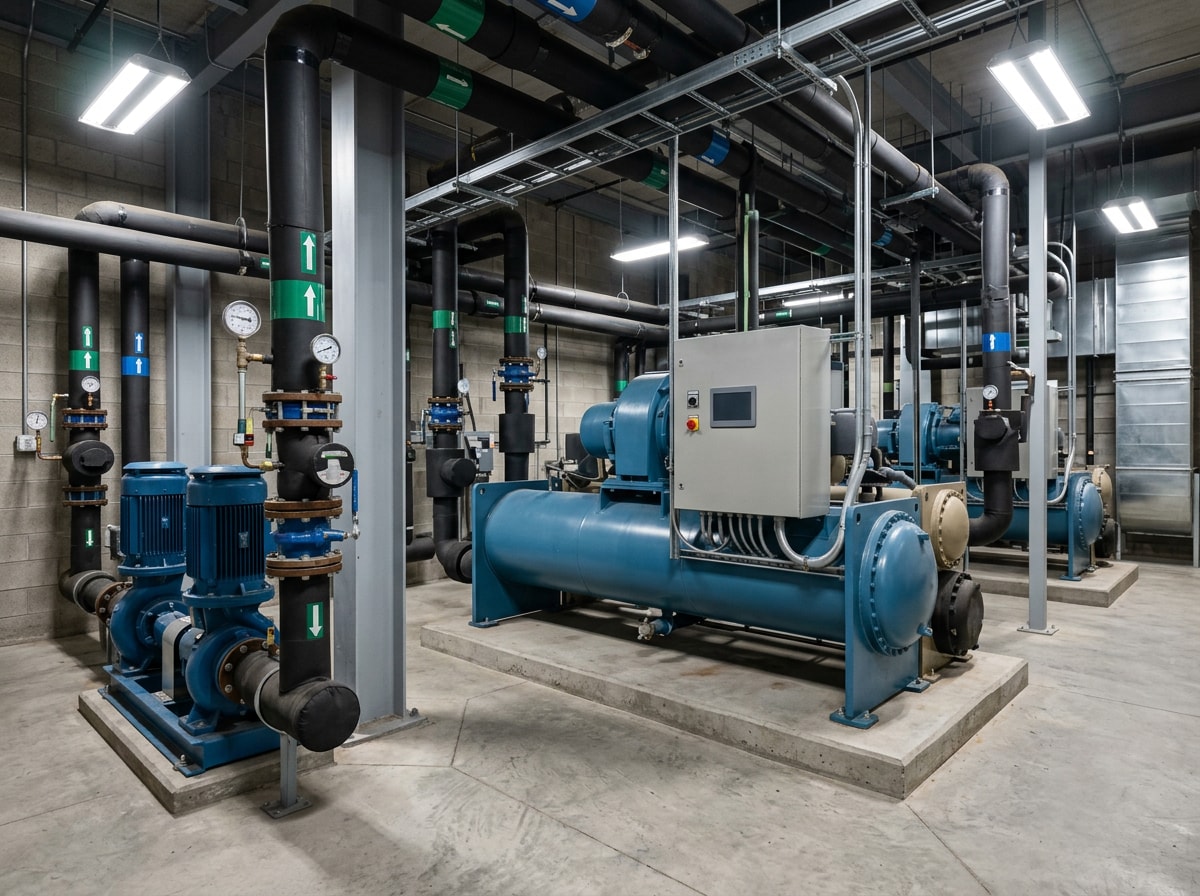
A commercial chiller is a mechanical system that cools water instead of cooling air directly. That chilled water travels through pipes to air handlers throughout a building, where fans push conditioned air into occupied spaces. That's the core difference between a chiller system and a standard rooftop unit, which cools and distributes air in a single step.
Chillers typically show up in buildings too large or too load-intensive for packaged rooftop units: large retail centers, light-industrial plants, agricultural processing facilities, and multi-story office buildings. If a property has multiple zones, heavy equipment heat loads, or square footage north of roughly 50,000 feet, a chiller is worth evaluating. Our crews have fielded this exact question from Grimes County building owners weighing a rooftop replacement against a central chiller plant, and the answer almost always comes down to zoning complexity, not just tonnage. Property owners comparing system types can start with our HVAC contractor services overview.
How Do Commercial Chillers Work?
A commercial chiller runs on a four-stage vapor-compression cycle: refrigerant absorbs heat from return water in the evaporator, a compressor pressurizes that heat-laden refrigerant, the condenser releases the heat outside, and an expansion valve resets the pressure so the cycle can repeat. Vapor compression chillers use reciprocating, screw, or centrifugal compressors to power the cycle , and that same basic loop is used across the industry whether the building is a hospital, a cotton gin, or a retail strip center.
Think of it like a sponge soaking up water, then getting wrung out somewhere else before soaking up more.
- In the evaporator, cool refrigerant pulls heat out of the warm water returning from the building.
- The compressor squeezes the refrigerant, raising its pressure and temperature.
- At the condenser, that heat gets dumped into outside air or cooling tower water.
- The expansion valve drops the pressure back down so the refrigerant is ready to absorb heat again.
This loop runs continuously, and the chilled water that results is what actually delivers comfort cooling to occupied spaces. Chillers are used in commercial buildings and industrial plants to provide air conditioning, refrigeration, and process fluid cooling , which is why you'll find the same core technology behind office comfort cooling and behind process cooling at a grain or feed facility.
Types of Commercial Chillers: Air-Cooled vs. Water-Cooled
Most commercial chiller decisions come down to one fork in the road: air-cooled or water-cooled. Both do the same basic job, but they reject heat differently, and that difference affects cost, space needs, and long-term efficiency.
Air-Cooled Chillers
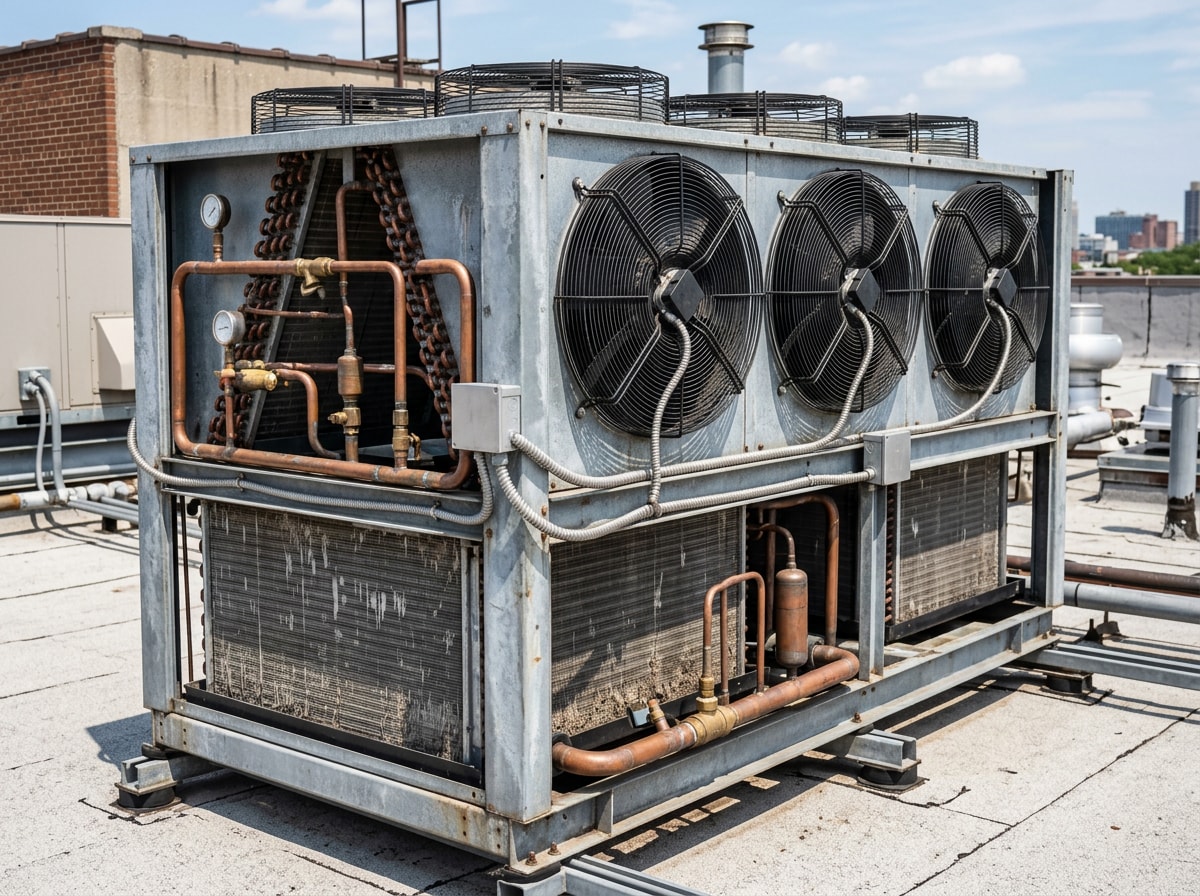
Air-cooled chillers reject heat directly into outdoor air using fan-driven condenser coils, no cooling tower or added water supply required.
This simplicity makes air-cooled units a common fit for small to mid-sized commercial buildings, especially where roof or ground space is limited and minimizing plumbing complexity matters. Installation tends to be more straightforward since there's no tower, sump, or water-chemistry program to manage. The tradeoff is that efficiency can dip during peak summer heat, since the unit is rejecting heat into air that's already hot.
Water-Cooled Chillers
Water-cooled chillers send heat to a cooling tower instead of straight into outdoor air, which generally gives better efficiency in larger facilities with high, steady cooling demand.
Because water absorbs and releases heat more efficiently than air, water-cooled systems often run with lower energy input per ton of cooling than air-cooled equivalents. That efficiency comes with added maintenance responsibility: cooling towers need regular water treatment, scale control, and periodic inspection. For facilities running near-continuous cooling loads, that extra upkeep is usually worth the operating savings.
| Feature | Air-Cooled Chiller | Water-Cooled Chiller |
|---|---|---|
| Heat rejection | Outdoor air via fans | Cooling tower water loop |
| Best fit | Small to mid-size buildings, limited space | Large facilities, continuous loads |
| Install complexity | Lower (no tower/plumbing) | Higher (tower, pumps, water treatment) |
| Peak-summer efficiency | Drops as outdoor air heats up | Holds up better under steady load |
| Ongoing maintenance | Coil cleaning, refrigerant checks | Tower water treatment plus coil/refrigerant checks |
Advantages of Commercial Chiller Cooling Systems
Chillers aren't just a bigger version of a rooftop unit; they offer real operational advantages for the right building. Chief among the benefits is consistent, even temperature control across multiple zones, something packaged rooftop systems often struggle with as building size grows.
Chillers also scale well. Adding capacity for an expansion or a new wing is often more straightforward with a central chiller plant than retrofitting multiple standalone rooftop units. Equipment longevity tends to favor chillers too: a well-maintained chiller plant can outlast several generations of smaller split systems, spreading capital cost over a longer service life.
Energy savings matter here as well. HVAC accounts for 44% of commercial building energy use on-site, according to the U.S. Department of Energy , which makes the choice between chiller types a direct line item on a property's utility bill, not just a comfort decision. Property owners evaluating new construction or a major retrofit can review options on our HVAC contractor page before narrowing down a system type.
Proper Chiller Sizing for Navasota, TX
Chiller sizing starts with a cooling load calculation, not a guess based on square footage alone. Contractors look at building size, occupancy patterns, equipment heat output, and how well the building envelope holds conditioned air before landing on a tonnage recommendation.
Undersizing leaves a building unable to keep up on the hottest days. Oversizing wastes capital and can hurt efficiency through excessive short-cycling. Getting the load calculation right up front saves money on both ends.
Climate Considerations for Navasota, TX
Navasota sits in Grimes County, and ASHRAE climate data places Grimes County in zone 2A , the same hot-humid classification as Houston. That means long, humid cooling seasons that push equipment harder and longer than a drier inland climate would.
That extended run time, combined with high humidity load, typically pushes sizing calculations toward a slightly larger safety margin than a dry-climate building of the same size would need. A chiller sized against outdated or generic design temperatures may underperform during a Brazos Valley heat wave, so working from current, location-specific load data matters more than it might for a mild-climate building. For sizing help tied to local conditions, our service area team in Navasota handles load calculations on-site rather than over the phone.
Commercial Chiller Installation Cost Breakdown
Chiller installation cost varies widely by tonnage, type, and site conditions, so a single number rarely tells the full story. Industry cost data for 2026 gives a useful planning range. The average chiller installation cost in 2026 runs $1,500 to $4,500 per ton, installed , and equipment makes up about half the total bill on most projects.
| Chiller Type & Size | Installed Cost (per ton) |
|---|---|
| Air-cooled scroll, under 50 tons |
$2,500 to $4,500
| Air-cooled screw, 50-200 tons |
$1,700 to $3,000
| New water-cooled plant with cooling tower |
$2,500 to $4,500
|
Several factors swing the final number beyond base equipment price:
- Roof or mechanical room access. Rigging and crane requirements add to labor cost, especially on older buildings without a clear crane path.
- Electrical service upgrades. Common on retrofit projects where existing panels can't support new equipment amperage.
- New or relocated cooling towers. These add both material cost and permitting time.
- Controls integration. Tying a new chiller into existing building automation can add scope depending on age and compatibility.
Getting a site-specific quote is the only reliable way to pin down real numbers for a given building. Our HVAC quote guide for Navasota breaks down what a detailed commercial estimate should include before you compare bids.
Ready to get real numbers for your property? Schedule a service visit and we'll walk through sizing, type, and budget together.
Keeping Your Chiller Efficient Year-Round
A properly installed chiller is only half the equation. Ongoing care protects both efficiency and the energy savings you were counting on when you made the investment. Chiller performance drifts over time without consistent upkeep, so a maintenance plan isn't optional for most commercial operations. Our HVAC maintenance and service agreements page covers the service tiers available for Brazos Valley properties.
Routine chiller maintenance centers on a handful of recurring tasks:
- Coil cleaning to keep heat-transfer surfaces free of dirt and debris
- Refrigerant level checks to catch slow leaks before they affect capacity
- Condenser or cooling-tower upkeep to prevent scale and biological buildup
- Electrical and controls checks to confirm the system is responding correctly to load changes
Skipping these basics doesn't just risk a breakdown; it quietly raises energy costs month after month as the system works harder to deliver the same output. Building-level benchmarking tools back this up: cutting a building's energy use by up to 30 percent is a realistic target when equipment is properly maintained and tuned, according to ENERGY STAR's commercial building program. Preventive maintenance scheduled around manufacturer recommendations and local operating conditions is the most reliable way to protect both equipment life and utility bills.
FAQ
What is included in a professional chiller maintenance visit?
A professional visit typically includes a full inspection, coil and condenser cleaning, refrigerant and electrical testing, and a performance check to confirm the system is operating within expected efficiency ranges. Technicians also document findings so trends can be tracked over multiple visits, which helps catch gradual performance decline before it becomes a failure.
How long does a commercial chiller last?
Most commercial chillers last between 15 and 25 years, though the exact lifespan depends heavily on maintenance quality and chiller type. Water-cooled systems often outlast air-cooled units when properly maintained, since they typically run at lower thermal stress. Deferred maintenance or poor water treatment can shorten that range considerably.
How often should a commercial chiller be serviced?
Service frequency depends on building load and how critical continuous cooling is to operations, but a reasonable baseline is quarterly inspections with a more thorough annual service. High-use facilities or buildings with tight temperature tolerances may need a more frequent schedule.
What's the difference between a chiller and a standard commercial AC unit?
A standard rooftop or packaged AC unit cools and distributes air directly in one step. A chiller cools water, then that chilled water travels through pipes to separate air handlers that distribute conditioned air. Chillers generally make more sense for larger, multi-zone buildings.
Is a chiller the right choice for a smaller Navasota business?
Not always. For most buildings under roughly 20,000 to 30,000 square feet with a single zone, a packaged rooftop unit or split system is usually simpler and more cost-effective to install and service. Chillers earn their keep in larger, multi-zone, or high-load buildings where central plant efficiency outweighs the added installation complexity. A site visit from our team can confirm which approach fits a specific building.
Thinking through a heating and cooling upgrade for your building? Take a look at our guide on choosing the right heating and air conditioning setup for more on matching equipment type to building needs, then contact us to schedule a site visit for your Navasota property.